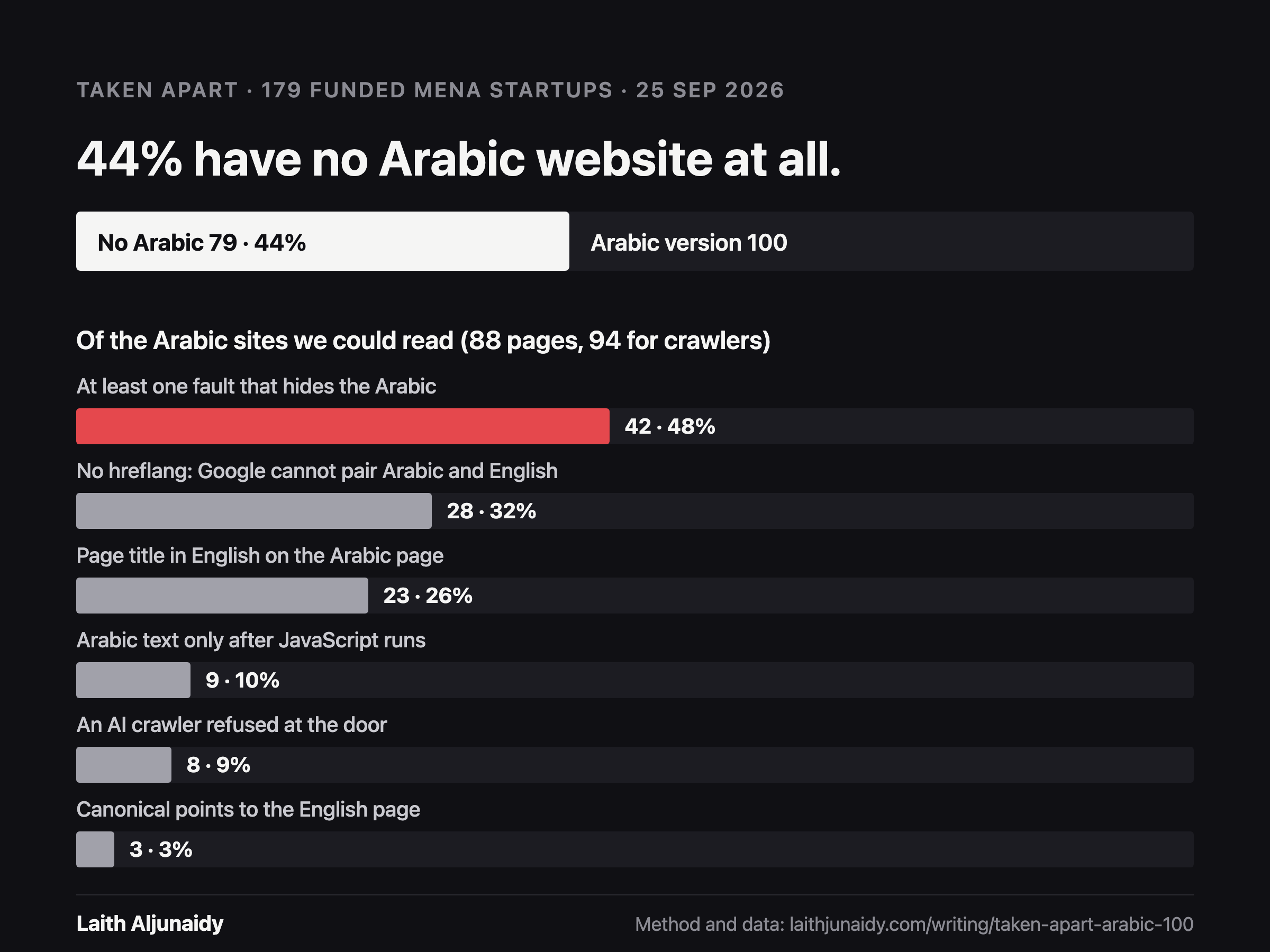
We checked 179 funded MENA startups. 44% have no Arabic website.
Taken apart, number two. A year of funding news, every company checked in order. Four in ten skip Arabic entirely, and half of the Arabic sites hide it from Google or ChatGPT.
On this page
Every founder in the region says the same thing about Arabic: of course we support it. I wanted to know what that means on the page, so I stopped asking and counted.
What I measured
I read Wamda’s funding news in order, newest to oldest, from 23 September 2026 back to 30 September 2025. Every company that raised money in fintech, e-commerce, delivery, proptech, health, edtech, mobility, SaaS or HR across nine MENA countries went on the list, and I checked each one in order until 100 had an Arabic version. Nothing was picked for having problems.
That took 184 companies. For the 100 Arabic sites I read the page the way three different visitors do: a phone, Google, and an AI crawler that does not run JavaScript.
Four in ten skip Arabic entirely
79 of the 179 companies with a website we could check have no Arabic version at all. That is 44 percent.
The country split is the real story. In Saudi Arabia, 8 of 66 funded startups have no Arabic site. In the UAE, it is 53 of 67. Four in five funded UAE startups present themselves in English only, in a country where Arabic is the official language.
Half of the Arabic sites hide it
Of the 88 Arabic pages we could read in full, 42 have at least one fault that keeps the Arabic away from search or AI answers. That is 48 percent.
- 28 have no hreflang (32 percent). Google cannot tell that the Arabic and English pages are the same content in two languages, so it guesses which one to show.
- 23 keep an English page title on the Arabic page (26 percent). That title is the blue line an Arabic searcher sees in Google.
- 9 have no Arabic in the page until JavaScript runs (10 percent). ChatGPT, Claude and Perplexity’s crawlers read the raw page, so to them the Arabic site is empty.
- 8 refuse an AI crawler outright with an error (9 percent). Only one of the eight says so in robots.txt. For the other seven it is a firewall rule, not a choice anyone made.
- 3 point Google at the English page as the original (3 percent), which tells Google the Arabic page is a copy.
The mobile layout, the thing people usually blame, was mostly fine: 4 of 94 pages slide sideways on an iPhone.
What this means if you build for Arabic users
Arabic support is treated as a translation job: get the words into Arabic and ship. The failures above are not translation failures. They are the small technical decisions around the words, the title, the hreflang pair, whether the text exists before JavaScript, what the firewall does with a crawler. Each one is an afternoon of work, and each one decides whether an Arabic speaker searching in Arabic ever finds you.
If you are in the 44 percent, the first Arabic page is the move. If you are in the 48 percent, your Arabic already exists. It is just not reachable.
Method and data
The scanner and the sample are open: scan.mjs, sample.csv and how the sample was drawn. Arabic version means a visitor can reach Arabic copy from the company’s own site. Pages were fetched on 25 September 2026 as a normal browser, as GPTBot, OAI-SearchBot, ClaudeBot and PerplexityBot, and in an iPhone 13 viewport. Five sites that block automated requests are left out of the page checks, and six whose Arabic switch keeps the same URL are left out of the text checks, so each figure states its own base. Results per company are not published; the aim is the pattern, not a list of names.
This is the second Taken apart: one question, measured by hand, method shown. If your Arabic site is in the numbers and you want to know which ones, ask me.